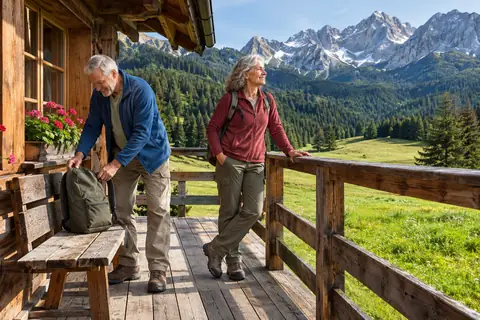
First minute mountain holidays for 2027-2028 are alpine and upland stays reserved many months before the season starts, usually in the spring or summer before a winter trip. Resorts in the Alps, Pyrenees and Dolomites release chalets, flats and hotel rooms early, and the best locations near lifts or trails disappear first. Winter breaks centre on skiing and snowboarding, while summer stays favour hiking, cycling and cooler air. Early reservations often come with reduced deposits and free changes up to a stated date, which suits families and groups planning around school holidays.
Two seasons, two kinds of mountain stay
Winter and summer in the mountains are almost different holidays. The snow season runs roughly from December to April in most alpine resorts, with high-altitude areas keeping reliable cover for longer. Summer stays, from June to September, centre on walking, cycling, lakes and the cooler temperatures that attract visitors escaping heat in the lowlands.
Demand is sharpest during school breaks, Christmas and the New Year, February half-term and Easter. Those weeks are priced at a premium and sell out soonest, so a family tied to a school calendar gains the most by reserving early, while flexible travellers can look at the quieter weeks of January or late March.
Shoulder periods in spring and autumn are quieter still, but many lifts, shops and restaurants close between seasons. A stay outside the main months suits those wanting solitude, though facilities should be checked beforehand rather than assumed.
Altitude also shapes the comfort of a summer stay. Villages above one thousand metres stay cool at night, thunderstorms often build in the afternoon, and early starts are the habit of experienced walkers who want to finish a route before the weather turns.
Chalets, apartments, hotels and mountain huts
Chalets suit groups and large families, giving separate bedrooms, a shared living space and sometimes a sauna or hot tub. They can be catered, with a cook preparing meals, or self-catered, which costs less but requires shopping and cooking. Catered options usually book up earliest because the number of staffed properties is limited.
Apartments in resort buildings are the most common choice. They range from compact studios to multi-bedroom flats, usually with a kitchenette and often within walking distance of the lifts. Prices fall for properties further from the slopes or in lower villages linked by a bus or gondola.
Hotels and guesthouses offer breakfast or half board, which removes the need to cook. Mountain huts and refuges, found on hiking routes, provide basic dormitory beds and meals, and in popular areas they must be booked months in advance during July and August.
Location within the village is worth a close look. Ski-in, ski-out properties command the highest prices, while a flat ten minutes from the lift can cost far less and still offer a short walk or a free shuttle, a trade-off that many groups accept.
Choosing a resort and checking the snow
Resort choice depends on ability and ambition. Beginners look for gentle runs, a good ski school and a nursery area, while confident skiers prefer large linked domains with varied terrain. Altitude matters, since higher resorts keep snow more reliably, particularly early and late in the season.
Snow conditions cannot be guaranteed months ahead, and operators rarely refund a stay because of thin cover. Choosing a resort with snow-making facilities, a glacier or north-facing slopes reduces the risk, as does travelling in the middle of the winter rather than at the edges.
Non-skiers deserve attention too. Villages with spa facilities, snowshoe trails, cinemas and cafés are better suited to mixed groups, and a car-free resort simplifies life for families who want to leave the vehicle behind for the week.
Deposits, insurance and cancellation conditions
A deposit is normally paid at booking, with the balance due four to eight weeks before arrival. Some owners and operators allow free changes until a certain date, while others retain the deposit for any cancellation. Reading these conditions carefully is essential for an expensive stay.
Winter sports insurance differs from standard travel insurance. It should cover medical treatment, mountain rescue and repatriation, and it often needs to include piste accidents. Cancellation cover for illness or injury before departure protects the investment made early.
Weather disruptions, such as avalanche warnings or road closures, can affect access, and policies on refunds vary. Understanding what is covered, and keeping contact numbers for both the accommodation and the lift company, helps when plans change at short notice.
Getting there and local transport
Many alpine resorts are reached by flying to Geneva, Zurich, Innsbruck, Salzburg or Turin and continuing by coach, private transfer or train. Transfers can take from one to four hours, and winter road conditions may add time. Early booking of both flights and transfers gives the best choice of times and fares.
Rail connections to the mountains are improving, with direct sleeper and day services to regions such as Austria and Switzerland. Arriving by train removes the need for snow chains and winter tyres, and many resorts provide free local buses for guests.
Driving gives flexibility but requires attention to winter equipment rules, tolls and parking charges. Some countries require snow chains or winter tyres between dates set by law, and parking near lifts may be limited or expensive in the busiest weeks.
Equipment, lessons and lift passes
Equipment can be rented at the resort or reserved in advance online, which often brings a modest reduction and saves queueing on the first morning. Beginners should consider lessons, since a few days of instruction make the week much more enjoyable and safer.
Lift passes are priced by area and number of days, and children and seniors normally receive lower rates. Buying online ahead of travel is often cheaper than purchasing at the ticket office, and multi-day passes save time at the lifts.
Summer visitors may need walking maps, a cable-car pass and sometimes a guide for glacier or via ferrata routes. Local tourist offices publish the opening dates of lifts, and those dates should be confirmed before building a hiking itinerary around them.
Children's clubs and nursery slopes are usually bookable ahead and have limited places, so families with young skiers should reserve them at the same time as the accommodation, along with helmets, which are strongly advised and compulsory for children in some countries.
Budgeting for a mountain stay
The main costs are accommodation, travel, lift passes, equipment, lessons and food. Eating in resort restaurants is more expensive than in lowland towns, so self-catering for some meals, or choosing half board, keeps the total predictable. Prices differ strongly between resorts, so figures should be compared case by case.
Early booking can reduce the accommodation share, since many properties publish their lowest rates first. It also allows time to compare resorts and to spread payments over several months, which many families find easier than meeting a large bill close to departure.
A small reserve for extras, such as parking, local tax, a taxi on a stormy night or a hot chocolate at the top of the lift, prevents the budget from being stretched by small and unplanned expenses.
Currency and payment habits are worth noting for Switzerland, where prices are higher and cards are widely accepted.
Companies that sell first minute mountain stays
- Crystal Ski Holidays — TUI brand selling ski holidays in the Alps and beyond.
- Inghams — Specialist in ski and walking holidays across Europe.
- Club Med — All-inclusive resort operator with mountain villages in the Alps.
- Ski Solutions — Tailor-made ski holiday specialist with advisers by phone.
- Skiset — Online booking service for ski equipment rental in many resorts.
- Booking.com — Global platform with chalets, apartments and hotels in mountain resorts.
- Airbnb — Marketplace for private chalets and flats in alpine villages.
- Interhome — Holiday home specialist with chalets in Switzerland, Austria and France.
Mountain stays and ski packages can be browsed and reserved with the specialist operator Crystal Ski Holidays. Crystal Ski Holidays