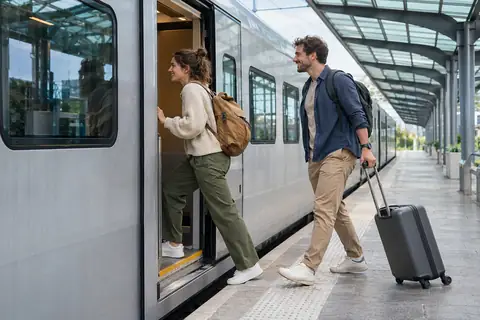
First minute train tickets for 2027-2028 are rail fares bought as soon as operators release their timetables, often several months before departure. In Britain, advance singles usually appear around twelve weeks ahead, while many European railways open sales between three and six months out. The fares are tied to a specific train, so they are normally cheaper than flexible tickets but harder to change. Seat reservations, night trains and cross-border services often sell out first. Buying early suits holidays, family visits and peak weekends, provided the traveller is confident about dates and accepts the conditions attached to the fare.
How advance rail fares work
Railways price most long-distance seats by demand. A limited number of cheap seats on each departure is released first, and the fare steps up as that allocation is used. Because the lowest prices are attached to named trains, a passenger who commits early generally pays less than someone buying on the day, although the exact gap depends on the route, the season and the operator.
Most networks publish their timetables well in advance, but not every train opens at once. Timetable changes, engineering works and the December and summer schedules can delay the release of particular services. For that reason a journey may be unavailable for weeks after the rest of the network opens, and checking back is worthwhile rather than assuming a service does not exist.
Advance fares are usually single tickets, so an outward and a return leg can be bought separately and even from different operators. Splitting a trip in this way sometimes brings the total down, and it also allows a flexible return to be chosen when the homeward date is uncertain.
When sales open in different countries
Opening dates vary widely. Britain releases advance tickets in rolling batches, typically up to about twelve weeks before travel, with occasional earlier releases for busy holiday dates. France, Germany and Italy tend to open longer windows, commonly three to six months, while Spain and Switzerland often fall somewhere between those figures.
High-speed and night services frequently open earliest, because demand is strong and capacity is limited. Sleeper berths between large cities and scenic routes through the Alps or along the coast can be fully booked long before the day-time services around them, so these are the trains to secure first.
Opening dates are published by each operator and sometimes change, so the safest habit is to note the date on which sales are expected and to look on that morning. Some operators and booking platforms offer an alert service that sends a message as soon as a chosen journey becomes available.
Fare types and the conditions behind them
The cheapest advance fare normally cannot be refunded and allows only limited changes, often for an administration fee plus any difference in price. Mid-priced semi-flexible fares allow a change before departure at a smaller cost, while fully flexible tickets can be used on any train within a stated period and refunded with minor deductions.
Reading the conditions before paying matters more than comparing the headline price. A passenger who misses a connection on a separate ticket may have to buy again, whereas a single through ticket usually protects the onward connection. Delays are covered by compensation schemes that differ by country and by fare type.
Railcards and passes interact with advance fares in different ways. Some discount cards reduce the price of advance tickets, others apply only to flexible fares, and rail passes covering several countries may still require paid seat reservations on high-speed and night trains.
Seat reservations, night trains and extras
On many European high-speed services a seat reservation is compulsory even for pass holders, and it is the reservation that sells out. Booking this early guarantees a place on busy Fridays, school holiday weekends and routes popular with commuters and tourists alike.
Night trains have regained popularity, with couchettes, shared sleepers and private compartments on offer. Private cabins are limited and are normally the first to go, particularly for summer departures and the weeks around major festivals. Early booking also gives time to choose between a seat, a couchette and a private room according to budget.
Extras such as bicycle spaces, assistance for reduced mobility and pet tickets often need to be arranged in advance and can have strict quotas per train. Travellers with large luggage, a bicycle or a wheelchair should secure these arrangements at the same moment as the ticket itself.
Planning connections and cross-border trips
International journeys involve more than one operator, and tickets for each leg may be sold through different websites. Booking the long leg first, then adding the shorter regional sections, usually works best because the cheapest long-distance fares are the scarcest.
Leave a generous margin at changeover stations, especially where passport checks are carried out, as on certain Channel and border services. A through ticket on a single reservation often provides better protection than separate tickets, since the operator must then help if the first train runs late.
Timetables for the following year sometimes shift in December, which can alter departure times of trains already booked. Operators normally contact passengers and offer a change or refund in that case, so keeping accurate contact details on the booking is an important and easily forgotten step.
Budgeting and avoiding common mistakes
A sensible budget starts with the cheapest advance fare for the chosen date and adds a margin for seat reservations, luggage, meals and local transport at both ends. Prices differ strongly by route, so a figure from one corridor should not be applied to another.
A frequent mistake is booking a non-refundable fare before holiday dates, leave or accommodation are confirmed. Another is overlooking the name on the ticket, since many advance tickets are personal and a spelling error can lead to a fee. Checking passenger names against passports, particularly for international trips, avoids avoidable problems.
Travel insurance that covers cancellation can protect the cost of a non-refundable fare when illness or a family emergency intervenes, though policies differ in what they accept. Reading the exclusions, keeping confirmations on a phone and carrying a printed copy are small habits that save stress on the day.
Flexibility, changes and what happens when plans shift
Even a carefully planned journey can change. Illness, a delayed flight or a revised holiday date may force a different departure, and the rules for altering an advance ticket decide how costly that is. Most operators let a passenger move to another train on the same day or a nearby date for a modest fee, provided the original train has not yet left.
Strikes, severe weather and engineering works occasionally cancel services. In such cases operators generally allow a free refund or a change to the next available train, though the arrangements and the evidence required differ between countries. Keeping the booking reference and a screenshot of the announcement speeds up any claim.
A useful compromise for uncertain plans is to book the outward leg early at the lowest fare and keep the return flexible until dates are firm. The saving on the first leg is retained, while the risk on the second is limited to a slightly higher price.
Companies that sell first minute rail tickets
- Trainline — Booking platform that sells rail tickets for Britain and many European operators in one place.
- Eurostar — High-speed operator linking London with Paris, Brussels and Amsterdam, with advance fares on its own site.
- LNER — Operator of the East Coast main line between London, Edinburgh and the north of England.
- Avanti West Coast — Operator of services from London to the Midlands, north-west England and Scotland.
- Great Western Railway — Operator serving the West of England and Wales from London Paddington.
- Deutsche Bahn — German national railway offering early saver fares on long-distance services.
- SNCF Connect — Booking service for French high-speed and regional trains.
- Rail Europe — Reseller of European train tickets and passes for international visitors.
Advance rail fares for Britain and Europe can be compared and booked through the Trainline platform. Trainline